
Hockeyklubban och Donuten – Maskulin och Feminin Ekonomi?
I recently listened to an interview with Kate Raworth, the creator of the Donut Economy, and it was brought up again that we have been striving for decades for an economy shaped like a hockey stick – a curve that points straight up. At the same time, Raworth offers a model shaped like a donut, with a balance between ecological limits and human needs.
Could it be that the traditional economic model is deeply rooted in a masculine logic – constant growth, dominance and penetration of markets? While the Donut Economy rather represents a more feminine, circular and inclusive view of resources and sustainability?
The classic "hockey stick" curve illustrates a curve where economic growth starts slowly but then skyrockets. It is often used to show that technological development and globalization have led to exponential economic expansion. The problem? We know that it cannot continue forever. Nature's resources are finite, and climate change shows that we have already gone far beyond planetary boundaries.
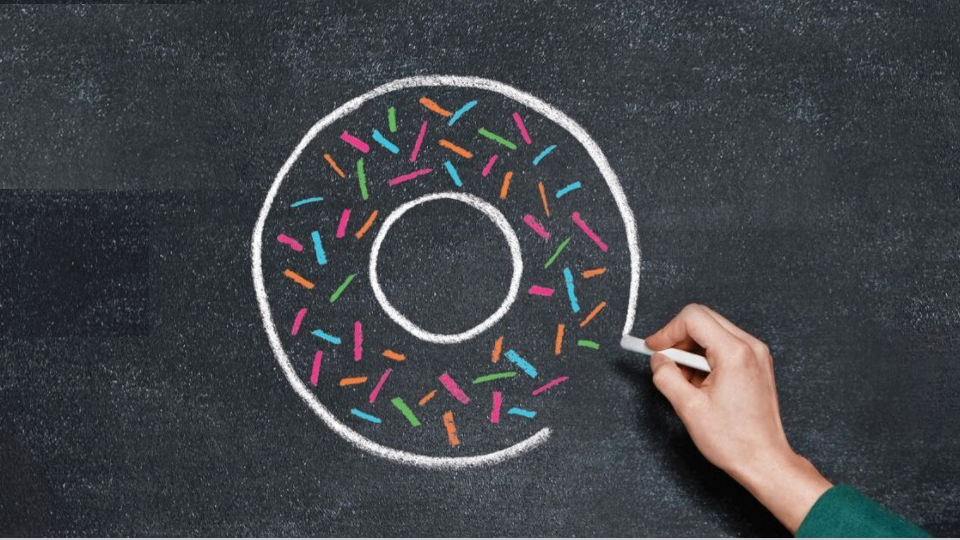
That's where the doughnut comes in. Raworth's model is about staying within a safe and fair zone – a circle where everyone has access to what they need, without us overusing the earth's resources. No endless growth, no "biggest winner", but balance and cooperation.
It is almost poetic how these two economic models, if you let your imagination run wild, can be seen as masculine and feminine archetypes. One aggressively expanding, the other empathetic and holding. And isn't it interesting that traditional economics, dominated by men, has stuck to the linear growth curve – while innovative economists, often women, are introducing more circular and balanced approaches?
So what can we learn from this? Perhaps we need to let go of the idea of perpetual growth and start thinking more like a doughnut – inclusive, regenerative and in balance with the planet. Or at least realize that the economic discussion needs to be broadened and not dominated by a single form of thinking.
What do you think? Is it time to put the hockey stick on the shelf and take a bite of the donut?